Showing posts with label sculpted live edge. Show all posts

Saturday, June 30, 2012

Lessons of a Lectern

Lou Quallenberg peeks through the crack in the Mesquite Lectern
Each new  project usually brings with it a set of lessons and insight into an artist's ability. We always find that each new project helps stretch and grow us in both art and in spirit.  The clients for this project: The Mesquite Lectern, have played a distinct role in stretching Lou Quallenberg artistically as well as spiritually and for that we are so very thankful.


The Lectern was part of the original order for the Chapel with the Dancing Trees and Benches/Pews. Since there was no specific time frame or deadline for this project Lou was able to develop the piece while working on other projects. This gave him a chance to play with the piece and in doing so, add a pop up shelf and small fold down reading light.

Lou stands next to the face of the lectern to establish size for the client progress report.
The project began with a unique slab from the same tree that the Dancing Trees were cut from. Lou wanted to save the shape of his unique slabbed piece of mesquite but also make it "Dance" alongside the Dancing Trees. 
Sketch of Mesquite Lectern
Lou's work almost always begins with a sketch. He usually has an idea of which mesquite slab he will be working with. That helps to develop the sketch which then gives the client a visual confirmation that he is moving in the right direction. 

The YouTube video below shows Lou Quallenberg & Shawn Walker as they begin to carve the Mesquite Lectern with a chainsaw.

Lectern begins to take shape
Progress report photos for the client.
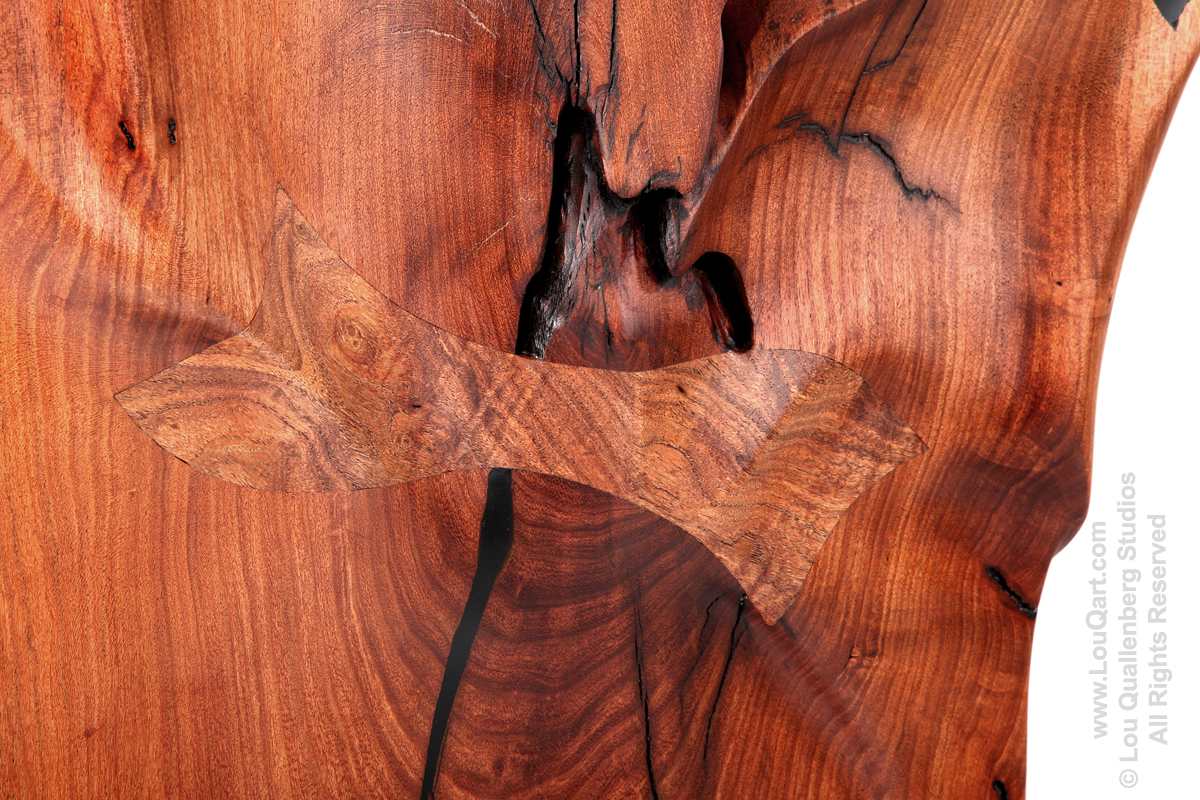
Lou Quallenberg's Signature Mesquite Bow Tie
Progress reports  and photos are regularly emailed to clients to keep them up to date on their special piece. This allows the client to help direct the design decisions that need to be made and gives them the feeling of participation as well as anticipation.


Lou Quallenberg's Signature Bow Tie  on the Lectern makes a  symbolic cross shape and holds the large crack in place.  We have several clients that request the Bow Tie even if it is not required structurally to hold their commissioned piece together. They like Lou's  Bow Tie purely as a design element. The  Bow Tie  on the Mesquite Lectern was also sculpted to add dimension and catch the light . This required an extra thick, BIG Bow Tie in order to to have room to sculpt it.

Lou with Lectern in the shop for @LAST Art Tour before the finish. 
Photo by John Hallowell - Highland Lakes Weekly

The Mesquite Lectern was in the shop for quite a while as Lou worked on other projects it even made an appearance, showing off its basic shape at the @LAST Llano ART Studio Tour.     


The Mesquite Lectern was professionally photographed by Lou before she was taken on delivery to her new home in the chapel alongside the Dancing Trees.  


Mesquite Lectern by Lou Quallenberg
Lou Quallenberg's Mesquite Lectern
Shelf DOWN Light UP
Shelf UP Light DOWN


Light from front in DOWN position.
Light side view in DOWN position.


Lou Quallenberg with his Mesquite Lectern
Many Lessons were learned as Lou Quallenberg stretched creatively and spiritually to create the Mesquite Lectern.

DELIVERY DAY
Arriving at the Chapel in the scenic Texas Hill Country
Entering the Chapel
Making its way into the Chapel towards the Dancing Trees
Mesquite Lectern in its rightful place alongside the Dancing Trees
The Dancing Trees and Benches admire their new friend the Lectern.
 A final touch goodbye


Monday, April 30, 2012

The "Susan" Mesquite Table: A "Birth" Day


Birthday Ride to Enchanted Rock
April is our birthday month here at Lou Quallenberg Studios.  Mine arrives first on the seventh followed a week later with Lou's on the fourteenth.  Two Aries rams butting heads until one of us decides to be the lamb. We celebrated mine  this year with a beautiful, bluebonnet filled ride to Enchanted Rock on the Harley.  Lou spent his in the shop where he is truly happiest working with his mesquite. I tried to get him out but he said it was his birthday and he could do what he wanted.

April is also the "birth"day for the "Susan" Table.  She was all finished up and delivered on Sunday the 29th. I know Lou felt a few pangs as he let her go.  She went to a very good home and we know she will be well loved for a few generations at the very least.

HAPPY BIRTHDAY Susan Table!!

Here is her story:

"Susan" Table Mesquite  Slab Top
We first met with the clients knowing that they wanted a mesquite table that would go in an entry way under a painting.  Lou had carefully selected several mesquite slabs for them to choose from.  When  she saw the slab that would become her table our client knew it was the only one for her.

Conception: Lou created a sketch based on the mesquite slab that was chosen and the process began.

Conception: Lou Quallenberg's sketch of the "Susan" Table


Once the sketch was approved the slab and it's flitch (the rest of the slabs from the tree) was taken to Brandon Berdoll in Cedar Creek. Where they were placed in his kiln for drying.  Brandon has kiln drying of mesquite down to a science and he provided us with regular moisture content readings throughout the entire process.  The mesquite was in the kiln for a good eleven weeks.

Mesquite slabs stacked and ready for the kiln
The Kiln


Final moisture content reading on mesquite slabs dried in the kiln
Once the slab and its sisters were all dried throughout to a 7.5% moisture content it was brought back to Llano to begin the construction process.
Removing the mesquite bark
After the basic shape was defined and the outer edges were cleaned up the base curve was copied and calculated to create the laminated curve that is a signature to Lou Quallenberg's mesquite work.
Calculating the curve for the table base
Once the curve is designed the jig to capture that curve is created and carefully crafted.
The jig that creates the matching curve
Lou Quallenberg in the shop with his curve creating jig

The Laminated Mesquite Base Curve and Leg Pattern
The "Susan" Table got a new set of legs.  Lou gave the leg design a bit more curve because he is always trying to improve the design and look of his mesquite furniture pieces.

Mesquite Table Clamped and Ready for Final Design Tweaking

A First Glimpse at How the Mesquite Table Will Look

The Mesquite Base Curves Finally Together


Curved Mesquite Base Ready for the Finish

Lou's finish is a two week process of lovingly hand sanding the tung oil based finish into every nook and cranny on the piece.

Applying the Finish to the Mesquite Slab Top
 He then rubs the piece with a cream wax to seal it all in.  It is so satiny smooth to the touch.

First Coat of Finish on the Mesquite Base

Mesquite Slab Top With the First Coat of  Tung Oil Based Finish
Curved Mesquite Base All Finished
When he is finished with his finish each piece calls out for you to touch it. We encourage the touching an rubbing of a piece.  Even the underside of his mesquite furniture pieces are as finished off as the top.

The "Susan" Mesquite Table Ready for Her Closeup and More

Photography is the next step of the process.  Lou photographs each piece utilizing his skills and experience in commercial photography. The "Susan" was photographed in Tom Suarez's Studio because she was too large to set up properly in the shop.  Lou's work is difficult to capture photographically because of all the curves and curves and curves.....

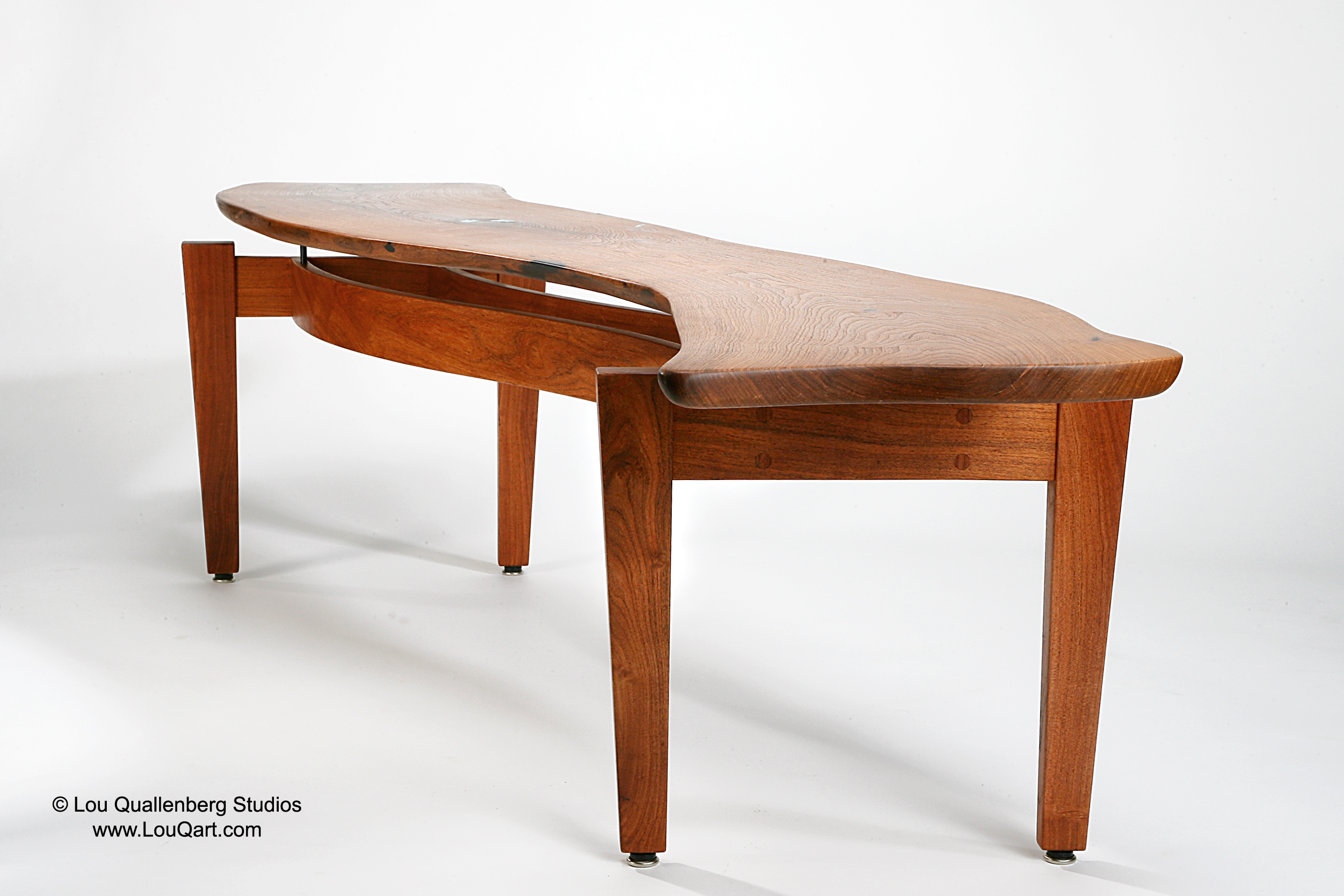
Lou Quallenberg's "Susan" Table in Mesquite 116"L x 24"W x 31"H


After her photos the "Susan" Table was ready for delivery. Once a piece is "delivered" to the client the process comes to an end  for us and the delivery date becomes each pieces "Birthday" in our catalog of Mesquite Furniture pieces. Where each piece is photographed and the original client/buyers name and location is recorded to help track the provenance of the individual pieces.


Check out Jamail's in Horeshoe Bay, Texas
So going along with the birthday theme, I mentioned last month that I have stepped back into the world of work and my first love: flowers. The birthing or start up of a grocery store is such an amazing thing to be a part of.  It is very much like the birth of a baby with a great deal of pain at the end,  along with the reward of shiny new entity.  I have been involved in several store start ups with HEB's Central Market being the biggest and most difficult. It is challenging, frustrating work, that is at times very exciting and ultimately rewarding. I have seen it make grown men cry many times over.

The Jamail Family has handled this overwhelming task with such grace and efficiency, producing a wonderful gem of a store in the heart of the Hill Country.  I hope the floral department that I create for them can hold up to their high standards in quality and value.  I can't wait to finally get my hands on some of these flowers I have been carefully sourcing and ordering. Because that is when the real fun begins.

Tuesday, January 31, 2012

'Every job is a self-portrait of the person who did it. Autograph your work with excellence'


"Every job is a self-portrait of the person who did it.  Autograph your work with excellence." -Anonymous

Each of Lou Quallenberg's mesquite furniture  pieces are signed, but even if they were not signed they are easily identified in several unique ways.

Lou Quallenberg's Signature Design Elements
  • Mesquite Wood Construction
  • Floating Live Edge Slab Tops 
  • Laminated Curved Bases
  • Clean Curved Design Style
  • Curves Upon Curves
  • Original Curved Bow Tie
  • Cracks, Holes and Character 
  • Artist's Signature


Artists began signing their work near the end of the Middle ages, first in France then spreading throughout Europe.  The practice of signing the work developed as art making left the hands of the Monks working collaboratively in Monastery workshops and individuals began to strive for greater artistic skill and recognition.


From 1890-1938 Pilkington's Royal Lancastrian Pottery produced some amazing pottery, tiles and glazes. I find the Makers Marks artistic pieces in themselves.
FROM SOCIETY WEBSITE: The pottery artists at Pilkington's each had their own distinctive mark. The male artists also used a specific mark to denote the year a vase was decorated. Whilst the tile artists occasionally put a mark or signature to their work this was not common. Some artists works are much more scarce than others which influences the value of an item. The marks of certain artists  for example Evans or Ormerod are very rarely seen.

The Society is able to identify most marks and the year of production for members. A stylized presentation of the marks is shown here.


 I recently read about the following  hidden signatures in the Steve Jobs biography.  It made me wonder if I might find something like this on the inside of one of our many old and outdated Mac's that we keep as a mini museum of all things Mac.  Most still work and are kept around for our
entertainment purposes only. I really liked the way Mr. Jobs wanted these computers to be considered art because it is how I think about them.
Signatures Inside an Early Mac
COPIED FROM www.folklore.org: "The Mac team had a complicated set of motivations, but the most unique ingredient was a strong dose of artistic values. First and foremost, Steve Jobs thought of himself as an artist, and he encouraged the design team to think of ourselves that way, too. The goal was never to beat the competition, or to make a lot of money; it was to do the greatest thing possible, or even a little greater. Steve often reinforced the artistic theme; for example, he took the entire team on a field trip in the spring of 1982 to the Louis Comfort Tiffany museum, because Tiffany was an artist who learned how to mass produce his work.
Since the Macintosh team were artists, it was only appropriate that we sign our work. Steve came up with the awesome idea of having each team member's signature engraved on the hard tool that molded the plastic case, so our signatures would appear inside the case of every Mac that rolled off the production line. Most customers would never see them, since you needed a special tool to look inside, but we would take pride in knowing that our names were in there, even if no one else knew."
I thought the example below of signing ones work was a great way to stay on top of quality control. Imagine if we all had to sign our name to our work (whatever it might be) before we released it out to the world. Taking ownership of whatever work we produced because we knew we had to sign it. I think those Big Mac's at McDonalds would actually look like the photos on the Menu.  I can see why these probably are the best axes in the world.  I want one just because I know the story and that the artist signed it.
COPIED FROM THEIR MARKETING MATERIALS:"Gränsfors axes are forged by very professional smiths. The proof of this professionalism is that they are able to forge axes with such precision that no supplementary work, to hide mistakes in the forging, is needed.

Image
Gränsfors axes are forged and signed by the smiths.
At Gränsfors Bruks, the forging craft is allowed to take its time. The smiths do not work by the piece. They take care and do the right forging from the beginning. There is no need to stone or grind or smooth or paint the axes in order to hide or eliminate imperfections in the forging. A smith at Gränsfors Bruks has nothing to hide and he is proud of his professional standards. When he is satisfied with his work and has accepted his axe, he marks the head with his initials beside the company's crown label:
LP: Lennart Pettersson, MM: Mattias Mattsson, BA: Bert-Ove Andersson
US: Ulrika Stridsberg, KS: Kjell-Äke Sjölund, RA: Rune Andersson
UN: Ulrik Nilsson, DG: Daniel Gräntz, AS: Anders Stromstedt
DP: Domingo Gas Pallares, TT: Tobias Thelin
Made in Sweden."


COPIED FROM SILVER HALLMARKS WEBSITE www.silverhallmarks.org.ukwww.silverhallmarks.org.uk:
Silver hallmarks are an invaluable aid to collectors and dealers for identifying the date & maker of antique silver, and indeed any piece of silver made in England.

Hallmarks on silver were first introduced in the UK in 1300 as a method of proving that the silver object contained the correct amount of silver, since pure silver is a very soft metal and consequently any object made from silver requires some base metal to be added to it to strengthen it.
In these early days it was not uncommon for silver objects to be melted down and converted into coinage, and so it was imperative that the silver used was of a sufficient grade, especially with continental silver containing a much lower percentage of silver.
Silver Hallmarks were the answer to this problem.Any piece of silver had to be officially approved to be of a high enough silver content, and would be given it’s hallmark only when this was the case.
As a consequence the hallmark became a standard of quality and assurance, and the presence of a hallmark on a silver object was an official seal of approval.
English silver, or Sterling silver is often referred to as solid silver, but it does in fact contain 7.5% copper, so it is 92.5% pure, which is why modern silver often has a .925 mark stamped into it. Continental silver is often only 80% pure.
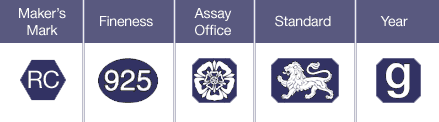
English Silver Hallmarks evolved over time, with the eventual inclusion of the standard or sterling mark, the assay office, the year of manufacture, the maker, and sometimes an additional mark for special reasons.
All of these silver hallmarks can help in identifying exactly when and by who any piece was made, which is not only helpful to collectors of antique silver, but also offers a fascinating dimension to any old silver object that you may possess.


So with all these beautiful examples of artists signing their work, I hope it inspires you to take ownership of your work - whatever it may be and remember that it is a reflection of yourself.  With that said we have restarted the video creation process to showcase  Lou Quallenberg's Mesquite Furniture making techniques and had hoped to post one with this blog post but it was just not ready for our signature.....


(This blog post was greatly inspired by a blog post, "would you sign your work" that Hubertus Von Lobenstein wrote in his blog that was inspired by a blog post that Tom Fishbourne wrote in his blog http://tomfishburne.com/ prior to his post dated January 2011.)


Monday, October 31, 2011

Delivery Day! Pew I mean Phew!


Well we delivered the mesquite benches/pews to the chapel in time for the upcoming wedding.  So now the "Dancing Trees" have an audience of eight that they can captivate all day long, as the light dances through the holes, ridges and ripples both natural and sculpted on the live edge mesquite slabs. Lou took the opportunity to give the "Dancing Trees" a good waxing and rub out - I think he just likes an excuse to spend time touching them.  

Wax on! Wax off! Dancing Trees by Lou Quallenberg
Thanks too the poor google map directions and a lack of communication, some on my part, but most on the lack of cell service in the area, our friends Laurie and Jim Branvik who live in Bandera and offered to lend a helping hand unloading and setting up the benches/pews, arrived as we finished assembling them in the Chapel.  They had not seen the "Dancing Trees" in their finished form so it was an opportunity to show them and reconnect, although very briefly. Jim is the Original Horseshoe Engraver and one of our favorite artist's to hang out with - of course we prefer it when Blondie is with him! 

The Chapel Benches/ Pews or shall we say seating?

Speaking of Jims' my cousin Jim gave us this little gem of a joke that I can't resist sharing:
Q: What happens if you fart in Church?
A: You have to sit in your own Pew!  (Wish they were all as beautiful as Lou's!)


The next part of the Chapel commission on the schedule is the Podium / Lectern. This will be another amazing sculpted beauty.  The mesquite slab is big and bulky and I often catch myself thinking of it as "Big Momma."  I can't wait to see what Lou Quallenberg does with this piece of mesquite. Check out the video of him having Shawn cut and shape it with the chainsaw:


http://www.louqart.com/coffeecurve.jpgWe will be showing an older piece (s-curve mesquite coffee table), that does not really reflect his current work style, at the Texas Furniture Makers Show since the crazy busy schedule this year prevented Lou from creating a new outstanding potential award winning show piece - maybe next year!? He will have a few mirrors and framed photography hanging in the Derby Gallery. Who knows ? maybe the s-curve will find a new home while on display.

Marta's New Logo

As for new homes we are sad to say that Riverbend Fine Art our Gallery in Marble Falls is closing in November. We really did enjoy the gallery space, art and artists, and of course the amazing Marta Stafford.  But as one door closes another opens and in January 2012 Marta Stafford Fine Art will open it's doors and we cannot wait to see what she does in this great new venue. We hope to have her continued representation in the Highland Lakes Area and wish her much success!

Much of my November will be spent along side MeMaw (my mother) as she undergoes knee replacement surgery on the leg that she broke in 1967when she fell out of a deer blind! They will be removing the old hardware and replacing it with a new knee and more modern techniques.  Please keep her in your prayers.